
How to Remove Toilet Limescale Without Damaging the Finish
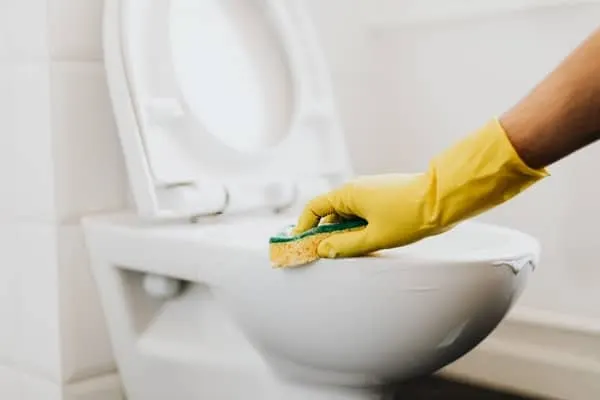
Limescale is a mineral deposit left by hard water; it is not the same thing as the water itself. A stained bowl can also have other causes. Check the toilet finish and the deposit before choosing a descaler, and keep bowl treatment separate from cleaning the seat, hinges and flush fittings.
- Choose a product approved for the bowl finish and follow its contact time.
- Do not mix descaler with bleach, disinfectant or another cleaner.
- Do not use sandpaper, a blade or a metal scouring pad as a general household method.
In this guide
- Check the surface and what is already in the bowl
- A controlled descaling process
- Why sanding and scraping are unsuitable defaults
- Persistent marks and later maintenance
Check the surface and what is already in the bowl
- Identify the toilet material and any special coating or decoration. Consult its care instructions.
- Check whether a rim block, in-tank product or cleaner has already been used. Do not add a chemically different product on top.
- Protect the seat, hinges, nearby stone and metal fittings from splashes.
- If there is a leak, poor flush or recurring deposit at a running-water line, arrange investigation of the fitting as well as cleaning.
The KOHLER K-3386: bowl, seat and fitting care restrictions distinguishes vitreous-china bowl care from plastic, plated and seat surfaces. It warns against strong abrasives and recommends a suitable commercial product for hard-water deposits. Permission for one component is not permission for all of them.
A controlled descaling process
- Read the cleaner label and the toilet instructions before opening the product. Provide the specified ventilation and personal protection.
- Confirm that incompatible products are absent and follow the manufacturer’s preparation instructions. Do not try to neutralise an unknown cleaner.
- Apply only to permitted bowl surfaces using the stated amount. Keep the product away from the seat and surrounding finishes.
- Leave it only for the stated time, then use a compatible non-scratching toilet brush if directed.
- Rinse or flush as directed and inspect. Do not leave strong product soaking overnight unless that is explicitly permitted.
If the product instructions or existing treatment are uncertain, stop and obtain advice. A second, stronger chemical should not be the automatic response to incomplete removal.
Why sanding and scraping are unsuitable defaults
Sandpaper and hard scraping can turn a removable deposit into a scratched finish. A damaged surface may remain visibly dull after the scale is gone. A pumice product is not a universal exception: use only where the toilet manufacturer explicitly permits it and follow its instructions.
Bleaching a stain and dissolving a mineral deposit are different jobs. Do not combine an acid descaler with chlorine bleach or another cleaner. The CDC: cleaning, disinfection and product directions advises following product directions and avoiding chemical mixing; a household recipe is not a compatibility test.
Persistent marks and later maintenance
If the deposit remains after a suitable labelled treatment, ask whether it is scale, another stain or existing surface damage. A specialist may need to assess it. Do not promise a like-new result for worn glaze.
Use the manufacturer’s routine care method afterwards and address any continuously running water. If you are moving out, compare the starting condition and the agreed cleaning checklist rather than interpreting every old mark as removable dirt.
Include bathroom condition in your property-cleaning enquiry
Tell Crown about heavy scale, special finishes and earlier chemical treatment. Accessible cleaning and any limitations should be agreed before booking; plumbing repairs are a separate task.
View end-of-tenancy cleaning and its checklist.
Sources and care guidance
Sources checked on 16 October 2026. Manufacturer guidance applies to the named products; use the instructions for your own item.