
How to Clean a Toilet and Remove Limescale Safely
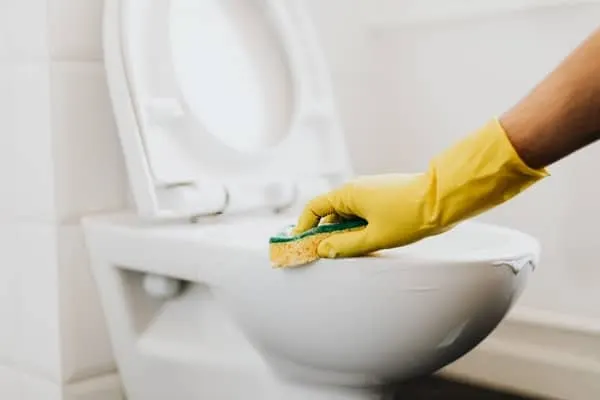
Cleaning a toilet means more than removing marks inside the bowl. The seat, lid, flush button, hinges and exterior need routine care too, with products suitable for each finish. Limescale is a separate mineral deposit left by hard water. Use the steps below for ordinary cleaning, then the descaling section where hard-water deposits remain.
- Choose a product approved for the bowl finish and follow its contact time.
- Do not mix descaler with bleach, disinfectant or another cleaner.
- Do not use sandpaper, a blade or a metal scouring pad as a general household method.
In this guide
- How to clean the seat, lid, button and exterior
- Routine bowl cleaning and when to descale
- Check the surface and what is already in the bowl
- A controlled descaling process
- Why sanding and scraping are unsuitable defaults
- Persistent marks and later maintenance
How to clean the seat, lid, button and exterior
Check the toilet and seat manufacturer’s instructions before choosing a cleaner. Keep toilet cloths and tools separate from kitchen and other household cleaning equipment. Allow ventilation and use the protection specified on the product label.
- Remove loose items. Use a soft cloth and a mild, compatible cleaner for accessible exterior surfaces; a bowl cleaner or descaler should not be spread over the seat or fittings.
- Work through the flush button or handle, cistern exterior, lid, both sides of the seat and accessible hinges. Use a fresh area of the cloth as you move to dirtier surfaces. Avoid soaking hinge gaps or special fittings.
- Clean the outside of the bowl and accessible base with a separate cloth. Do not reach into electrical connections or dismantle a shower toilet.
- Wipe away cleaner residue as the instructions require. Dry permitted surfaces and hinge areas with a soft cloth; check that splashes have not reached nearby metal or stone.
- Clean and store the tools according to their instructions, keep toilet-only cloths separate, and wash your hands after removing gloves.
The KOHLER care guide separates bowl, seat and fitting care. Painted, plated and plastic components can have different restrictions, so a product approved for the bowl should not be assumed suitable for all parts.
Routine bowl cleaning and when to descale
For ordinary soil, use a cleaner approved for the bowl material. Apply it inside the bowl as directed, allow its stated contact time, use a compatible non-scratching toilet brush where permitted, then rinse or flush as instructed. Keep bowl-cleaner splashes off the seat, hinges and exterior.
If a hard, chalky deposit remains, check whether it is limescale before selecting a descaler. Follow the controlled descaling steps below rather than adding another chemical to the existing cleaner. Do not mix or layer descaler, bleach, disinfectant or household ingredients.
Cleaning, disinfection and a workable routine
Clean visible soil when it appears and give frequently touched areas regular attention. Adjust the routine to how the toilet is used instead of relying on a universal timetable. Check for leaks or continuously running water if marks keep returning.
Cleaning and disinfection are different tasks. If disinfection is needed, clean first and use a product suitable for that exact surface, following its contact time, ventilation and rinsing directions. CDC guidance explains this distinction and warns against mixing products. A vinegar-and-bicarbonate recipe should not be presented as a universal disinfectant.
Check the surface and what is already in the bowl
- Identify the toilet material and any special coating or decoration. Consult its care instructions.
- Check whether a rim block, in-tank product or cleaner has already been used. Do not add a chemically different product on top.
- Protect the seat, hinges, nearby stone and metal fittings from splashes.
- If there is a leak, poor flush or recurring deposit at a running-water line, arrange investigation of the fitting as well as cleaning.
The KOHLER K-3386: bowl, seat and fitting care restrictions distinguishes vitreous-china bowl care from plastic, plated and seat surfaces. It warns against strong abrasives and recommends a suitable commercial product for hard-water deposits. Permission for one component is not permission for all of them.
A controlled descaling process
- Read the cleaner label and the toilet instructions before opening the product. Provide the specified ventilation and personal protection.
- Confirm that incompatible products are absent and follow the manufacturer’s preparation instructions. Do not try to neutralise an unknown cleaner.
- Apply only to permitted bowl surfaces using the stated amount. Keep the product away from the seat and surrounding finishes.
- Leave it only for the stated time, then use a compatible non-scratching toilet brush if directed.
- Rinse or flush as directed and inspect. Do not leave strong product soaking overnight unless that is explicitly permitted.
If the product instructions or existing treatment are uncertain, stop and obtain advice. A second, stronger chemical should not be the automatic response to incomplete removal.
Why sanding and scraping are unsuitable defaults
Sandpaper and hard scraping can turn a removable deposit into a scratched finish. A damaged surface may remain visibly dull after the scale is gone. A pumice product is not a universal exception: use only where the toilet manufacturer explicitly permits it and follow its instructions.
Bleaching a stain and dissolving a mineral deposit are different jobs. Do not combine an acid descaler with chlorine bleach or another cleaner. The CDC: cleaning, disinfection and product directions advises following product directions and avoiding chemical mixing; a household recipe is not a compatibility test.
Persistent marks and later maintenance
If the deposit remains after a suitable labelled treatment, ask whether it is scale, another stain or existing surface damage. A specialist may need to assess it. Do not promise a like-new result for worn glaze.
Use the manufacturer’s routine care method afterwards and address any continuously running water. If you are moving out, compare the starting condition and the agreed cleaning checklist rather than interpreting every old mark as removable dirt.
Include bathroom condition in your property-cleaning enquiry
Tell Crown about heavy scale, special finishes and earlier chemical treatment. Accessible cleaning and any limitations should be agreed before booking; plumbing repairs are a separate task.
View end-of-tenancy cleaning and its checklist.
Sources and care guidance
Sources checked on 9 November 2026. Manufacturer guidance applies to the named products; use the instructions for your own item.